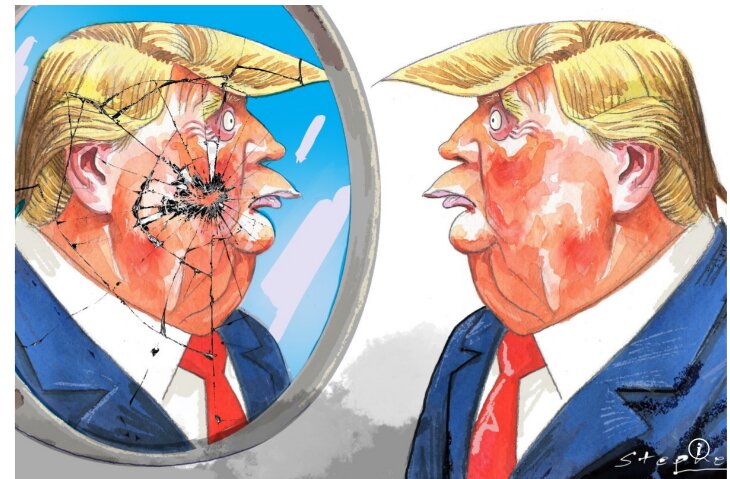
Every ego empire eventually falls
HAFIZABAD, Pakistan - The tensions between the United States and Iran did not begin overnight. Their roots trace back to the 1979 Iranian Revolution, yet over the decades the conflict evolved into something far more dangerous and unpredictable.
At times, American naval fleets move through the Persian Gulf; at other moments, new sanctions tighten pressure on Tehran. Israel’s growing involvement, repeated threats, and aggressive rhetoric have added further instability to an already fragile region.
Amid this global confrontation, the personality and leadership style of Donald Trump became impossible to ignore. His political approach has often been shaped by confrontation, dramatic statements, and emotionally charged communication. Late-night social media posts, sarcastic attacks on opponents, and direct warnings toward Iran gradually became part of international headlines.
For many observers, the concern was never limited to foreign policy alone. It was also about temperament, ego, and the impact personality-driven leadership can have on global affairs.
American actor Robert De Niro once described Trump as a “sociopathic, psychopathic malignant narcissist,” reflecting the intensity of criticism surrounding his public behavior. Beyond Hollywood, several psychologists and commentators also expressed concern about the broader consequences of leadership centered around self-image and emotional dominance.
The term “malignant narcissism” was originally introduced by Erich Fromm, a German-born psychologist who escaped Nazi Germany and later studied authoritarian personalities, including Adolf Hitler. Fromm described malignant narcissism as a combination of extreme self-obsession, aggression, lack of empathy, paranoia, and an unhealthy desire for control.
Psychologist John Gartner was among those who publicly warned about these concerns during Trump’s rise in American politics in 2015. He argued that a personality heavily driven by ego, impulsiveness, and emotional reactivity could become dangerous not only for domestic stability, but also for diplomacy and international balance.
Several books further expanded these debates. The Dangerous Case of Donald Trump brought together psychiatrists and psychologists who argued that Trump’s conduct posed risks to democratic institutions and public stability. Another work, The Episodic Man, explored the connection between identity, personality structure, and modern political leadership.
Trump’s niece, Mary Trump, offered another perspective in her book Too Much and Never Enough. She described a family environment shaped by emotional coldness, relentless competition, and the constant pursuit of dominance. According to her interpretation, Trump’s personality developed around validation, image, and fear of weakness.
Critics argued that many aspects of his political behavior reflected these patterns. Public humiliation of opponents, intolerance toward criticism, obsession with loyalty, and endless self-promotion became recurring elements of his public image. Supporters interpreted this conduct as confidence and strength. Opponents viewed it as a dangerous personalization of power.
In recent years, even artificial intelligence entered this discussion. AI-generated images portraying Trump in exaggerated heroic forms spread widely online. Some supporters treated them as harmless humor or internet culture. Others interpreted them as symbols of an increasing obsession with admiration and self-glorification. In the digital era, political mythology is no longer built only through speeches or television appearances. It is reinforced through algorithms, viral imagery, and carefully crafted online identity.
History repeatedly shows that when narcissistic personalities gain enormous power, the consequences rarely remain limited to one leader alone. Entire nations can become trapped
in cycles of division, emotional manipulation, fear, and institutional decline. A country may continue appearing powerful from the outside while slowly weakening internally.
The danger begins when loyalty to an individual becomes more important than truth, accountability, or democratic principles. When ego starts driving national decisions, destruction often becomes the fate of the country itself.
Many critics now argue that Trump’s personality and leadership style have deeply polarized and psychologically exhausted American society. The slogan “Make America Great Again” was presented as a promise of national renewal, yet opponents believe the country has instead become trapped inside a climate of anger, division, and political fantasy. In their view, America is no longer moving toward unity or stability, but drifting deeper into an imagined world shaped by personality cults, emotional conflict, and endless confrontation.
History does not always collapse in fire and revolution. Sometimes it rots slowly, through weakened institutions, manufactured crises, and unchecked ego at a time.
Every ego empire falls eventually. No matter how loud, powerful, or untouchable it seems.
The Iran war exposed it again: when leaders start believing they are bigger than institutions, bigger than laws, bigger than humanity itself, collapse is only a matter of time.
And as Donald Trump falls, history repeats the same brutal lesson:
Power built on ego always destroys itself in the end.
Leave a Comment